
A blog series exploring stock market life from a listed company CEO’s perspective
Last week I took a break from publishing the blog because I was on the HS Vision Podcast (in Finnish), discussing the revival of the Helsinki IPO scene with Elina Lappalainen.
On the podcast, I aired my forecast publicly for the first time: in ten years, there could be 400 companies on the Helsinki stock exchange. That would mean the number of listed companies doubling, and it would make Finland, alongside Sweden, one of Europe’s leading “capital markets for everyone”. By this I mean that instead of small circles or foreign capital, our domestic growth companies and their success would be owned to a greater extent by domestic capital, including ordinary citizens.
My optimistic view is based on the cultural shift I have seen over 15 years. Today, listing is an option for many entrepreneurs, and for many it is a dream.
That was not the case in September 2012, when a journalist from Taloussanomat called me wanting to interview me about Siili Solutions’ listing on First North. I was just as puzzled by the topic as the journalist was. First North, the leftover list where you could find Eirikuva Digital Image Oyj? Siili Solutions, an IT consultancy with revenue of just over EUR 10 million that nobody had heard of? Planning to raise just EUR 1.5 million by going public?
In 2012, few growth entrepreneurs considered the stock exchange an option. The general perception was roughly that a company had to be close to Wärtsilä in size, with annual dividends of EUR 100 million, for the stock exchange to be realistic.
Exactly ten years after that moment, 70 new companies had listed on Nasdaq Helsinki’s First North, and 14 of them had already moved on to the main market. The growth market had come back to life. It took the first companies leading by example to break the ice.
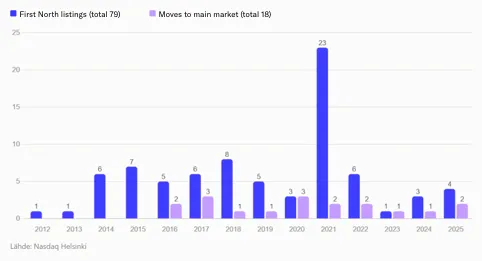
I am talking about First North and small-cap listings because they play a key role when we talk about growing the number of listed companies. As I see it, the first First North wave went down in history in the years 2012–2022. After that, the market froze because of the hangover that followed the 2021 bubble. But if all goes well, the next cycle is now beginning, and it will be stronger than the previous one.
So what draws growth entrepreneurs to the stock exchange? I speak for myself and many other entrepreneurs when I say that the underlying idea is retaining a certain degree of control and independence. If a company needs credibility, capital and more muscle for its growth, the stock exchange is a mechanism for achieving that without giving up extensive control of the company. The company gains a diversified shareholder base and can be developed with a timeless philosophy, compared with, for example, an investor who comes on board with a predetermined time horizon to develop the company. The stock exchange also offers a mechanism through which the shareholder base can live its own life and renew itself naturally as the company goes through its stages of development. Life as a listed company does of course bring its own challenges and burdens, which I have written about in earlier parts of this blog.
In addition to the cultural shift, this development is fuelled by the rapid growth of our startup and growth company ecosystem. In ten years, there will certainly be many companies listed in Helsinki that have not even been founded yet. Finland has also seen the emergence of growth company financing platforms such as Springvest, which also help lower the threshold to the stock exchange. There is also more information and more service providers available for carrying out a listing, although admittedly we advisors still have a huge amount of work to do on our part to lower the threshold in terms of cost and complexity.
Fortunately, Finland has more and more innovators, like Siili’s team at the time and their CEO Seppo Kuula, who have the courage to do things differently from everyone else. Siili was a stock market success, and in the ten years after its listing the company grew tenfold. The stock exchange essentially enabled Siili to execute an acquisition-driven strategy and gave the company an unfair competitive advantage over unlisted players in the consolidation game among IT service companies. (Siili’s difficulties after the IT market frenzy ended in 2022 are another story, but they do not erase the success of the previous decade.)
Let’s check the maths: is my calculation realistic? Growing the number of listed companies to 400 from today’s level would require an average of 25 listings per year, assuming that 1.5% of listed companies also leave the exchange each year. The figure is undeniably ambitious, but I believe Finland has enough growth companies, and enough investors and capital, to make this possible. If, on top of this, taxation, political decisions, lower listing costs and technological development were to smooth the path to the stock exchange a little, the idea is not entirely impossible. Stockholm, with its thousand listed companies, has already shown that it can be done.
